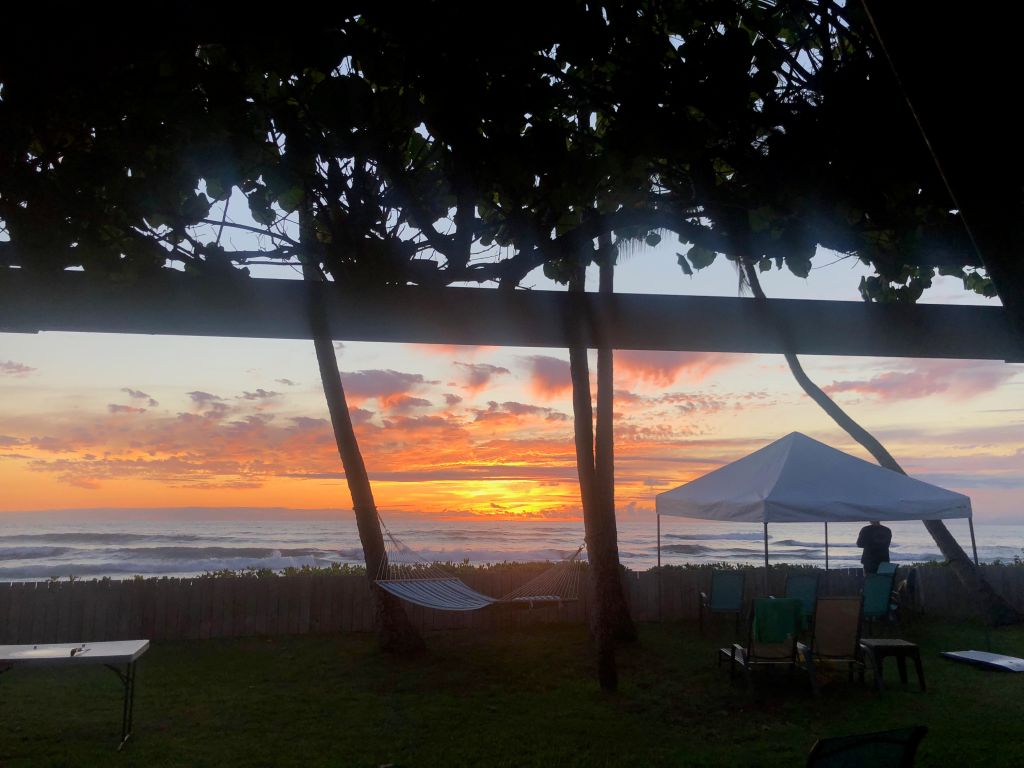
It’s 11:45am on Thursday and there are approximately thirty surfers scattered up and down the reefy, underwater peninsula of Ma‘ili Point on the west shore of O‘ahu. I’m posted beneath a pop-up tent in my backyard toggling between technical documents, zoom meetings, and the all-too-frequent overhead sets rolling into the bay. I’m fortunate on a number of fronts, and this recent disease outbreak has done nothing but highlight these privileges. As a young person working in tech in San Francisco (who would have thought), job security is (at least it feels) stable and working from home comes naturally. Whispers of a pending quarantine meant cheap flights to Hawai‘i and in a matter of hours I was back in the water in front of my childhood home of 18 years.
Mid-spring on the west side of O‘ahu — which catches both early south and late north swells — means almost constant waves. Ma‘ili Point juts straight out to sea and catches every bump thrown its direction. This morning, it is the tail end of a solid, slowly fading West-North-West swell. Every few minutes a new set pops out of the blue and bends across the exposed reef. It’s crowded. More crowded than I ever really remembered as a kid. Granted, the waves are good. Really good. But in my chest I know it’s not simply the epic forecast. There is something more going on here.
Hawai‘i in general, and Waianae more specifically, relies heavily on service work. The quick response by the State is no-doubt saving lives, but perhaps at the expense of the blue-collar workforce of the islands. Tourism has grinded to a halt, stores and restaurants have shut their doors, and the State budget is as frugal as ever. People are losing jobs amidst the driest job market in the history of our country.
Unlike our west-coast surfing counterpart, California, Hawai‘i has yet to criminalize the ocean. And they have shown no such signs of doing so yet. Despite the closures of beachparks (and the release of State employed Lifeguards), the ocean is still open and there are as many people in the water as ever. Much of this can be credited to the Hawai‘i Supreme Court and their Public Access Shoreline Hawai‘i (PASH) Ruling of 1993 which essentially protects Native Hawaiians from any coastal restrictions. Most coastal states, and coastal countries in general, having completely locked down oceanic access. But this 27-year old Ruling is allowing Native Hawaiians and Haoles alike to continue to enjoy everything the equatorial Pacific has to offer.
It’s no wonder why it’s so crowded on this mid-morning Thursday. In a time where the world seems to be in turmoil, unemployment rates have ski-rocketed, and the uncertainty tomorrow — let alone a month from tomorrow — can be immobilizing, the reliability of a west-facing pointbreak has more lure than ever.
Yesterday evening, I sat out the back with four locals, waiting for one of those clean-up sets of the growing swell. The sun rested heavily behind a thin cloud, casting a mellow orange film over the west side of the island. The hard off-shore wind gave the surf some bite, and the picturesque moment felt like the cover of a Surfer’s Journal Magazine. For the most part, we sat quietly, soaking in the world with a child-like stupor — hooting each other into sets as they rolled along. But just as the sun began to break, and a bump started to appear on the horizon, a quick conversation sprouted between two of the locals.
“How’s da family, Kawika?”
“We good.”
“How you? Still get work?”
“I’m good. No get work, though.”
Kawika then turned and paddled into a screamer. His words, like the salty, glowing spray, floated in the air around the rest of us.
 BAMBOOBLISTER
Leave a comment